
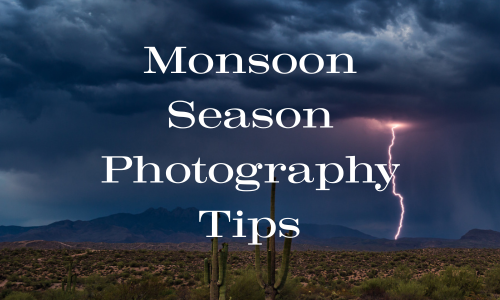
If you’ve lived in Oro Valley (or the Greater Tucson Area) for even one summer, you know the exact moment the atmosphere shifts. In our home, our cat Lucky alerts us in advance of coming storms by fleeing to the depths of my closet. Although there is something I like about every season here, monsoon season is pretty hard to beat. The lightening shows are spectacular and the heavy rain seems to just cleanse and wake up everything. The incredible electric displays against the backdrop of the Catalina mountains makes for one heck of a photo!
Capturing the brilliance of these storms requires a bit of strategy, though. Before we even look at a camera lens, safety must be prioritized. A desert storm is a powerhouse of energy, releasing a torrent of lightning strikes. While it is incredibly tempting to stand out on the patio to watch the clouds roll in, the National Weather Service reminds us that even covered patios do not protect you from lightning. The safest vantage point for this shoot is actually completely inside your home, capturing the storm through a (clean!) window or a sliding glass door. If you are out on the road, staying inside a hard-topped metal vehicle is your next best option. Forget the old rules of trying to count the seconds between the flash and the boom; the updated guidelines states if you can hear thunder at all, you are close enough to be reached by a strike.
When it comes to the technical setup, the foundation of a great photo is exactly like the foundation of a great home—it must be rock solid. You simply cannot hold a camera by hand and expect a crisp lightning shot, so a sturdy tripod is non-negotiable. If you are using a professional DSLR or mirrorless camera, the secret is to stop trying to "snap" the lightning and instead let the lightning take its own picture. Switch your camera to manual mode, turn your focus to manual, and set it to infinity so the distant mountains stay perfectly sharp. Keep your ISO low at one hundred or two hundred because lightning flashes are incredibly bright and set your aperture around f/8 to f/11 to ensure whatever you are shooting is clear top to bottom.
The real magic happens with your shutter speed, but there is a crucial distinction to make based on the time of day. If you are shooting after dark—which is when the monsoon truly puts on a neon show—you will want to keep your shutter open for a long exposure of fifteen to thirty seconds. This way, you aren't frantically trying to time the flash; the camera stays open, waiting to record the bolt whenever it decides to strike. However, because many of our monsoon storms hit during the late afternoon, keep in mind that leaving a shutter open for thirty seconds in broad daylight will completely blind your camera with white light. For those daytime storms, you will want to use a fast shutter speed with burst mode or invest in a specialized glass attachment called a Neutral Density filter to block out the harsh afternoon sun. You can also buy triggers for interchangeable lens digital cameras to mount on the hot shoe (mounting bracket usually located on the top of the camera) and plug into the remote shutter release.
If you are working with the smartphone in your pocket, you can still achieve a magnificent result without all the gear. Utilizing long-exposure apps like Slow Shutter Cam or Lightning Camera can automate the timing for you. Alternatively, holding down your phone’s burst mode button during the absolute peak of the storm will allow you to sort through the frames later to find that one perfect, electric moment.
Regardless of your equipment, remember that our local topography is a “must have” costar. A bolt of lightning in an empty sky is fine, but one that illuminates the rugged crags of the mountains or silhouettes a saguaro is an absolute masterpiece. Try placing the mountains in the lower third of your frame to let the vast moody sky tell the majority of the story.
Monsoon Photography Cheat Sheet
Safety
Download: A radar weather app to keep an eye on where the storm is tracking and its intensity.
Listen: When thunder roars, go indoors. If you can hear it, you are within striking distance.
Positioning: Shoot strictly from inside a building through a window, or from completely inside a hard-topped metal vehicle. Avoid patios and carports.
Gear & Stability
Tripod Essential: Lock your camera or smartphone down on a tripod; any movement during a long exposure will blur the entire image.
Remote Shutter: Use a remote trigger or your camera’s built-in two-second timer so your finger doesn't shake the lens when you press the button.
Smartphone Apps: Download a dedicated long-exposure or lightning-trigger app to assist with daytime or nighttime storm tracking.
Camera Settings (DSLR/Mirrorless)
Mode: Manual (M) with Focus set to Manual "Infinity."
ISO & Aperture: Keep ISO at 100 or 200 to handle the bright flash, and Aperture between f/8 and f/11 for sharp mountain details.
Night Shutter Speed: 15 to 30 seconds (allows the camera to catch the lightning automatically while open).
Day Shutter Speed: Use a fast shutter speed with high-speed continuous shooting (Burst Mode) or attach a Neutral Density (ND) filter to allow for longer exposures without overexposing.
Composition Strategy
Rule of Thirds: Position the mountain horizon in the bottom third of your viewfinder.
Add Scale: Frame a saguaro cactus or desert tree silhouette in the foreground to give the image depth and distinct Arizona character.
For more about the monsoon season, please visit our “The Monsoon—it’s not a storm, it’s a season!” article. Looking for tips to stay cool this summer? Our “Summer is Coming” article has you covered!
Check out this article next